Resilience
Karana is the main character in Island of the Blue Dolphins. She is the only human being on the island. Living alone on the island tests her resilience, and as the story progresses, Karana grows through her experiences into harmony with herself and the world around her. She learn many new skills and how to fight at what ever that comes her way.
In the the book Karana begins to feel lonely as the wild dogs kill her only family, Ramo. Karana swears that one day she will kill all the wild dogs. When she is on the verge of achieving this goal, however, and has the opportunity to finish off the head of the pack, she does not kill it. Instead she brings the head (whom she later names Rontu) back to her house and nurses him back to health.
Another important aspect of Karana is her resilience. Though the white men's ship doesn't return for her until eighteen years later. Her efforts to establish a comfortable life on the island are repeatedly and she never shows signs of despair and she never gives up. She is always looking ahead to her next task on the island.
Links:
http://www.sparknotes.com/lit/dolphins/summary.html
http://www.sparknotes.com/lit/dolphins/canalysis.html
http://www.sanedraw.com/NOTEBOOK/ISLANDBD.HTM
Thursday, July 5, 2007
Resilience_2.0

Moral development
Summary (taken bits from each examples):
When Karana is first left alone on the island, her moral ideology is more or less identical to that of her people. As the story progresses, however, Karana develops her own moral code. The laws of Karana's tribe forbid women from making weapons, a fact that Karana struggles with constantly as she pits superstition against necessity. The first time she makes weapons, she is very fearful; the second time she is less fearful but still nervous; the third time, when she makes the spear to catch the devilfish, she does so without any misgivings. Indeed, she makes that spear almost as a hobby, for catching devilfish is not a necessity.After Karana has befriended a number of the animals of the island, she decided not to kill anymore animals on the island again kill any of these animals. This is a significant decision, because she is dependant on a number of these animals for material.When she was first marooned, she used animals for food and tools and clothing. However, she considers animals to be very much like people, even though they do not talk. She knows that her tribesmen would consider her resolution ridiculous, but her animal friends are so important to her that she cannot bear to kill them.
Labels:
Group 3

Wednesday, July 4, 2007

Survival
Karana make weapon e.g. arrows,sword,spear,bows and etc.Karana also make huts/house to protect herself from wild dogs/wild animals.She also gather food and keep in a safe place so that she will not be hungry.Food that she gather is e.g.fish and etc.
She also make canoes to help her moving around the island.She also make hideout to hide herself when the aleuts come.She also keep a dog to protect her house.
Courage-syakir
hhttp://www.curledupkids.com/isldolph.htm hhttp://dimdima.com/bookbuzz/show_books.asp?q_bid=80&q_title=Island%20of%20the%20Blue%20Dolphins
http://content.scholastic.com/browse/book.jsp?id=2353
Labels:
Group 3
Forgiveness
In chapter seven, Karana demonstrates her empathy for others as she dives into the ocean to go after her brother. This is a pivotal moment in the text that reveals Karana as a uniquely caring and empathetic individual. She has been responsible for Ramo for most of the story thus far, and takes a motherly attitude toward him. Jumping into the sea, however, seems above and beyond the call of duty—Ulape, who is just as much a sister to Ramo as Karana, does nothing.She forgive her sister for not jumping down with her to save their brother's life. Karana also was raging with anger as she swam towards her brother. But as soon as she reaches the shore, she hug him instead of doing the things she planned while she was swimming.
Taken from: http://www.sparknotes.com/lit/dolphins/section4.rhtml
When one day, she waited for the dogs to come out of their cave. She was a smart girl so, she gathered as many brush and lit them. Then, she threw them in the cave. Dogs began to come out. She shot two of them. Leaving with three arrows, she wanted to save it for the leader. The leader came out, but it did not run away as the others. Instead, it stand there starring at Karana. Karana did not waste time and shot an arrow. The arrow hit it's chest. It began to run. She shot another arrow but she misses. The remaining arrow she use it to kill another two dogs. She searched for the wounded dog. She found it. She wanted to kill it but on second thought, she cleaned its wound and keep it. She knows that it is still alive. She have the heart to keep it although it killed her brother. They became good friends. She decided to call it Rontu. Karana has many enemies and no friends. She lives with the vague fear in the back of her mind that one day the Aleuts that killed her people will return to the island. Eventually, Karana is forced into confrontation with the Aleuts. In each case she has the opportunity to take her revenge, but doesn't. The case of Tutok is the most important of these because it shows the development of Karana's trust in more detail and to a deeper extent (in the case of Rontu, the only thing Karana and Rontu to show trust was refrain from killing each other).
Taken from:http://www.sparknotes.com/lit/dolphins/themes.html
In this section, Karana finds herself truly alone for the first time. Karana and Ramo enjoyed each other's company, and Ramo even said that he preferred to be on the island of the blue dolphins with his sister when there are no other people around. Karana starts to feel the pangs of loneliness when she is on the shore waiting for Ramo. She begins to wonder whether the white men's ship will ever come and begins to experience fear for the first time since she was left on the island with Ramo. Her fear becomes panic when Ramo does not return, and to anger when she finds him dead. She forgive her tribe for not trying to stop the ship and wait for Karana and Ramo. They just wanted to turn over a new leaf at the other island that they were going.
Taken from:http://www.sparknotes.com/lit/dolphins/section5.rhtml
Labels:
Group 3
Tuesday, July 3, 2007
Survival
http://72.14.253.104/search?q=cache:VH8SmlpEDGAJ:www.penguinreaders.com/downloads/9780582416383.pdf+island+of+the+blue+dolphin+chapter+8+karana+survival&hl=en&ct=clnk&cd=1&gl=sg
http://72.14.253.104/search?q=cache:GWTySyXpAlcJ:ww.glencoe.com/sec/literature/litlibrary/pdf/island_blue_dolphins.pdf+island+of+the+blue+dolphin+chapter+8+karana+survival&hl=en&ct=clnk&cd=13&gl=sg
http://72.14.253.104/search?q=cache:Xvks0Uks9v4J:www.uh.edu/hti/cu/2003/7/03.pdf+island+of+the+blue+dolphin+chapter+8+karana+survival&hl=en&ct=clnk&cd=32&gl=sg
Labels:
Group 3
Resilience
Links:
http://www.sparknotes.com/lit/dolphins/section14.rhtml
http://www.sanedraw.com/NOTEBOOK/ISLANDBD.HTM
http://www.sparknotes.com/lit/dolphins/canalysis.html
Labels:
Group 3
Sunday, July 1, 2007
Discussion Director Luke (Chap 8)
Chap 8
1. Do you think the relationship between Karana and Ramo got stronger as they were on the island alone ?
2. How would you feel if you went back to your home to find animals messing up the whole place looking for food ?
3. How do feel about their life style compared to ours modern life style ?
4. Do you think that Ramo aka Chief Tanyositlopai is ready to chief ?
Saturday, June 30, 2007
Island of the Blue Dolphins
This book is based on the true story of Juana María the "Lone Woman of San Nicolas," a Nicoleño Indian marooned for 18 years on San Nicolas Island off the California coast.
More About Juana María :
In 1811 hunters began scouring the California coast for otters, whose pelts were affectionately referred to as "soft gold". As the intensity of the hunting took its toll the otters nearly became extinct on many islands although San Nicolas was, at the time, mostly untouched. Under contract to the Russian-American Company approximately 30 Aleuts from Russian Alaska were hired to hunt otters for several weeks on San Nicolas Island. Unfortunately, this outing grew into a year, and a bloody conflict among the otter trappers and islanders (who opposed the hunting) drastically reduced the population of the local men. By 1835 the island's Native American population, which had once numbered 300, had shrunk to around 20 individuals. Some sources give the number as 7, all female except for one man named Black Hawk.
When news of the massacre reached mainland the Santa Barbara Mission decided to sponsor a rescue operation. In late November 1835, the schooner [a type of sailing vessel] the remaining Native Americans living on San Nicolas Island. Upon arrival to the island Hubbard's party gathered the Indians on the beach and brought them aboard. Juana María, however, was not among them by the time a strong storm arose, and the Peor es Nada's crew, realizing the imminent danger of being wrecked by the surf and rocks, panicked and sailed toward the mainland, leaving behind María. A more romantic version tells of María diving overboard after realizing her child had been left behind, although archeologist Steven Schwartz notes "The story of her jumping overboard does not show up until the 1880s… By then the Victorian era is well underway, and literature takes on a flowery, even romantic flavor."This version is recorded by María's eventual rescuer, George Nidever, who heard it from a hunter who had been on the Peor es Nada; however, he makes it clear he may be misremembering what he heard.
Hubbard brought the islanders to San Pedro Bay where many chose to live at the San Gabriel Mission. The missions, however, despite their best intentions, had a high fatality rate as the Indians had no immunity to Old World diseases. Black Hawk, the last male islander, reportedly became blind shortly thereafter, and drowned after falling from a steep bank. Hubbard was unable to return for María at the time as he had orders to take a shipment of lumber to Monterey, and unfortunately, within a month the Peor es Nada sank at the entrance to San Francisco Bay after hitting a "heavy board" which caused the schooner to roll "over and over and over" until it sank. A lack of available ships in the mid-1830s delayed any further rescue attempts.
Rescue In 1850, Father Gonzales of the Santa Barbara Mission paid Thomas Jeffries $200 to find María, though he was unsuccessful. However, the tales Jeffries told upon returning managed to capture the imagination of George Nidever, a Santa Barbara fur trapper, who launched several expeditions of his own. He failed to find her at first, but on an attempt in 1853, one of Nidever’s men, a Carl Dittman or Charley Brown, discovered human footprints on the beach and pieces of seal blubber which had been left out to dry. Further investigation lead to María's discovery, who was living on the island in a crude hut partially constructed of whale bones. She was dressed in a skirt made of greenish cormorant feathers.
Afterwards, María was taken to the Santa Barbara Mission, but was unable to communicate with anyone. The local Chumash Indians could not understand her, so the mission sent for a group of Tongva or Gabrieleno who had formerly lived on Santa Catalina Island, but they were unsuccessful as well. Four words and two songs recorded from María suggest she spoke one of the Uto-Aztecan languages native to Southern California, but it is not clear to which branch it is related. A University of California, Los Angeles study by linguist Pamela Munro focusing on the words and songs suggests that María's language was most similar to those of the Luiseños of Northern San Diego County and of the Juaneños near San Juan Capistrano. Both groups traded with the San Nicolas islanders and their languages may have had some influence. This evidence, when taken as a whole, suggests that María was a native Nicoleño. However, other scholars contend that because all attempts to decipher her dialect by local Indians were in vain, María may have been the descendant of an Aleut man and a Nicoleño widow. Life at Santa Barbara Mission María was reportedly fascinated and ecstatic upon arrival, marveling at the sight of horses, along with European clothing and food. She was allowed to stay with Nidever, who described María as a woman of "medium height, but rather thick… She must have been about 50 years old, but she was still strong and active. Her face was pleasing as she was continually smiling. Her teeth were entire but worn to the gums."María apparently enjoyed visits by curious Santa Barbara residents, singing and dancing for her audiences.
One of the songs María sang is popularly called the "Toki Toki" song. Knowledge of this song came from a Chumash man named Malquiares, who heard María sing it, and later recited the words to his friend Fernando Kitsepawit Librado (1839 – 1915). The song's words are as follows:
Toki Toki yahamimena (x 3) weleshkima nishuyahamimena (x 2) Toki Toki…(continue as above)
Librado recited the words to Aravio Talawiyashwit, who translated them as "I live contented because I can see the day when I want to get out of this island"; however, given the lack of any other information on María's language; this translation dubious, or perhaps an intuitive guess. Anthropologist and linguist John P. Harrington recorded Librado singing the song on a wax cylinder in 1913. The following text was published by an anonymous writer in a Sacramento newspaper on October 13, 1853:
“The wild woman who was found on the island of San Nicolas about 70 miles from the coast, west of Santa Barbara, is now at the latter place and is looked upon as a curiosity. It is stated she has been some 18 to 20 years alone on the island. She existed on shell fish and the fat of the seal, and dressed in the skins and feathers of wild ducks, which she sewed together with sinews of the seal. She cannot speak any known language, is good-looking and about middle age. She seems to be contented in her new home among the good people of Santa Barbara.”
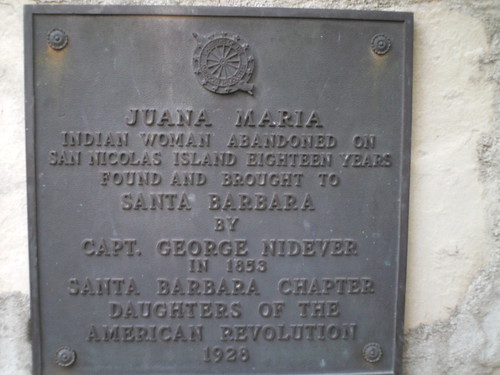
Death Just seven weeks after arriving on mainland, María died. Modern analysis suggests she contracted dysentery, but Nidever claimed her fondness for green corn, vegetables and fresh fruit after years of little such nutrient-laden foods caused the severe and ultimately fatal illness. Before she died Father Gonzales baptized her and christened with the Spanish name Juana María. She was buried in a grave on the Nidever family plot at the Santa Barbara Mission cemetery. In 1928 a plaque commemorating her was placed at the site by the Daughters of the American Revolution. Here is a picture of her grave stone:
María's water basket, clothing and various artifacts including bone needles which had been brought back from the island and were part of the collections of the California Academy of Sciences were destroyed in the 1906 San Francisco earthquake and fire. Her cormorant feather dress was apparently sent to the Vatican, but it appears to have been lost.
Film
A film version of Island of the Blue Dolphins was released on July 3, 1964. It was directed by James B. Clark and starred Celia Kaye as Karana. Jane Klove and Ted Sherdeman adapted the script from O'Dell's novel, and the film was produced by Robert B. Radnitz and Universal Pictures. The film was made on a slight budget and did not receive a wide release, and reviews were mixed.
Labels:
Group 3
Who are The Aleuts ?

Aleut Hunter
Aleut men honored the sea mammal spirits by wearing highly decorated hunting costumes. This hunter is dressed in a gut-skin kamleika ornamented with yarn, applique designs, and hair embroidery. Sea lion whiskers on the hat indicate the hunting ability of its owner. Large glass beads, most of Chinese origin, attest to his wealth. In his hands are a sea otter dart and throwing board.

Labels:
Group 3
Thursday, June 28, 2007
Character Analyzer-(Island Of The Blue Dolhins,Chapter 8)
In this Chapter
Karana: Lonely ,Panics when Ramo(her brother) did not return. Frightened,Angry when Karana saw Ramo dead.Enjoyed the company with Ramo. Independent.
Ramo:Enjoyed the company with Karana.Responsible yet defiance .Nothing mush to him as he died a terrible death protecting himself against the wild dogs on the island.
Labels:
Group 3
Discussion Director Luke (Chap 4)_2
CHAP 4
1. If you where an Aleut, how would you feel cheating on a tribe that is less fortunate than you ?
2. How do you think Karana felt when her father did not get up ?
3. How do we know that Karana pays attention to details?
4. If you where one of the tribe women, do you think you would cry in delight when you saw the necklaces ? (Note: Think like a woman in their time, their situation and there life style)
5. What when through your mind as you read the part about the fight between The Aleuts and the Tribe people ?
6. Do you think the author wrote " As Ulape and I ran along the cliff a whirring sound like a great bird in flight passed above our heads ", please express how you feel about this line.
Labels:
Group 3
Wednesday, June 27, 2007
plot analyzer
From the first paragraph we know that the aleuts were packing their things.They did it as fast as they could.The sky was sunless and dark clouds were forming, signaling rain. The scene became chaotic when the aleuts broke their promise & gave jewellery instead of otter pelts.MY father shook his head,he was not pleased.
Labels:
Group 3
Vocabulary Wizard (Chapter 4)
CHAP 4
1. Sunless - it tells that something bad is going to happen
2. Filled with otter - it tells us that they wanted to take all otters without paying
3. The Aluets laughed - it tells us that they are sure that they can get away without paying
4. Shook his head - he wanted his share
5. Scarcely - feeling scared
6. Excitement - feeling happy to get a treasure chest
7. Gaze - look around his surrounding
8. Harmlessly - it did not injure anybody
Labels:
Group 3
Tuesday, June 26, 2007
Character analayzer-Island of The Blue Dolphins,Chapter 4
In this chapter
Karana : A fainthearted yet brave girl who was looking what was happening on the shore from afar.
Chief Chowig(Karana's father): Held his responsibilities as chief and stood his ground against the Aleuts. He fought till his death.
Aleuts: Cruel and unfair. He is a leader of the Aleuts and not a trustworthy person.
Labels:
Group 3
Connector(Chapter 4)
Captain Orlov is like people who did not keep the promise so Karana father and all of the people on the island fight for their purpose because the Aleuts hunt animals on their land and didn't return what they had promise like the real life people fight for the country,rights,position.Some fight for other people but they didn't get anything in return.
Labels:
Group 3
Disscusion Director (Chap 4)
CHAP 4
1. Why did the men from the tribe bring their weapons ?
2. Why did the women hide in the bushes ?
3. How do we know that Karana roughly understand what her father was talking about ?
4. Why did the women cry in delight when they saw saw the necklaces ?
5. How did Karana felt when her father did not get up ?
6. Did the tribe win the battle ?
7. Why did some of the tribe male tribe members stay at the foot of the trail and not retreat ?
Labels:
Group 3
Sunday, May 27, 2007
Our Roles Group 3
Group Members: Luke, Hakim, Syakir,Amirul and Qhairiq
1)Dicussion Director - Luke
2)Plot Analyzer - Syakir
3)Vocabulary Finder - Hakim
4)Connector - Amirul
5)Character Analyzer - Qhairiq
Labels:
Group 3
